How much code does a hypermedia designer need?

Hypermedia Programming.
How much code does someone who designs hypermedia need to know today? In class I chose not to answer with a syllabus but with a map: I drew on the board the technological resources a designer has at hand, arranged from low code to code, so we could see the whole landscape and open the discussion from there.
The question has no single answer, but the map shows where the most interesting part lies: not at the most comfortable end, but in a zone that was only hinted at on the board.
The class set out to review the landscape of creative possibilities a hypermedia designer has today and, from there, to discuss how much programming they need to practice their professional role. Instead of starting from a language or a tool, we started from the question.
We walked through the map along an axis that runs from low code to code. At one end are content management systems such as WordPress and Notion, where you publish without writing code. Next comes the infrastructure: GitHub, GitHub Pages, Codespaces, version control and Copilot as an AI assistant. In the middle, HTML, CSS and JavaScript, which reach the browser; Teachable Machine as a doorway into machine learning; and the path that goes from an API to data in JSON, to databases and to information systems. Toward the code end, the DeepSeek API, system prompts and Python. Everything converges in what the map calls AI-powered systems for hypermedia programming.
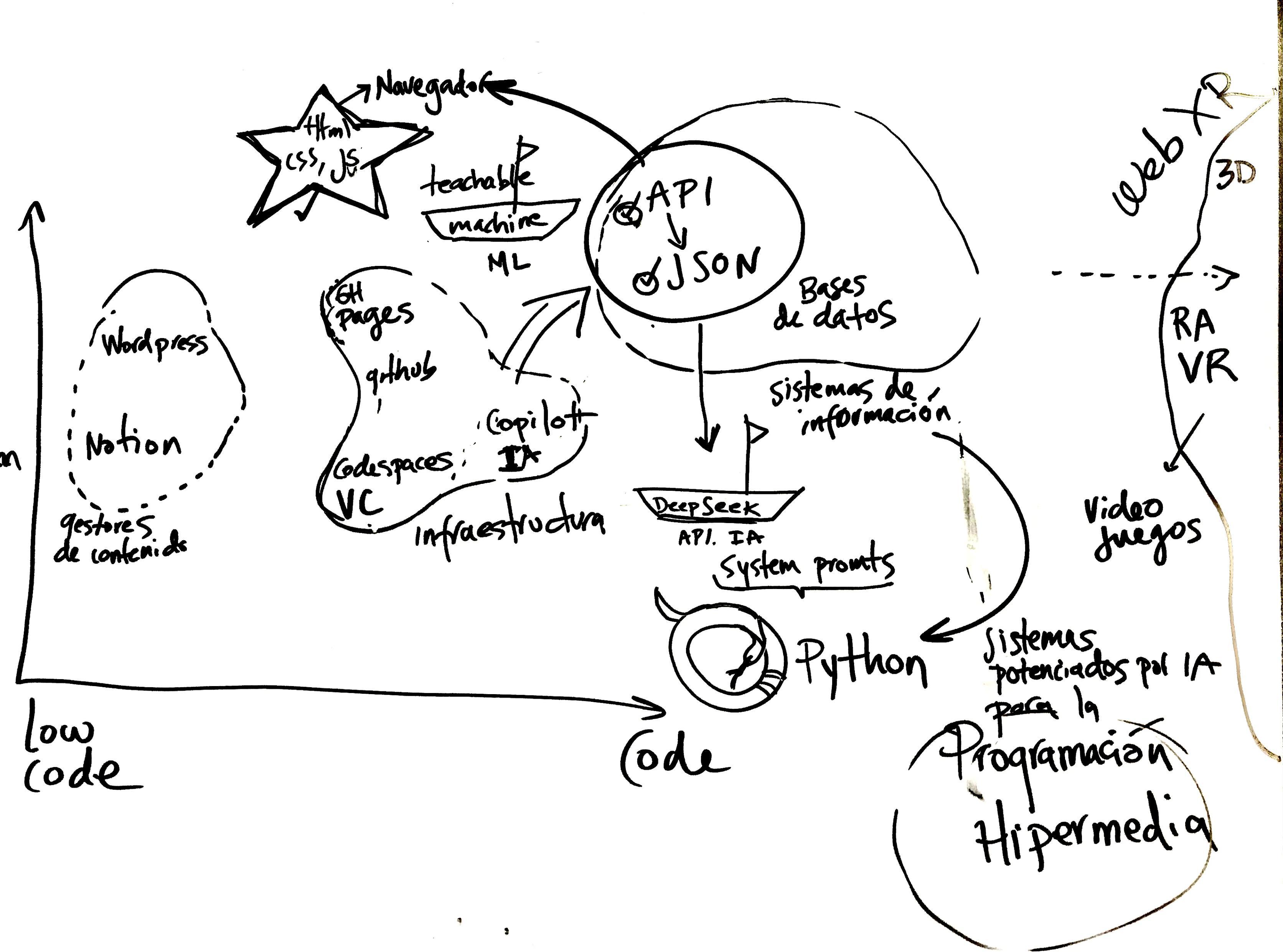
At the edge of the board were WebXR, 3D, augmented and virtual reality, and video games. With the whole map in view, the class opened up to discussion.
The map hints at a zone I did not fully draw: gamification. It is the zone of more complex interaction and programming structures, and at the same time the most relevant to hypermedia design.
That is where game engines come in. With them, what we design is no longer limited to a page: it can be an online, multiplayer experience, and it can even leave the screen. Through the serial port, a game engine can communicate with embedded physical systems such as Arduino or ESP32, and interaction comes to involve objects, sensors and spaces.
If that is the zone most relevant to the craft, a hypermedia designer's reach in programming cannot stay at the low-code end: it has to reach the interaction structures that make those experiences possible.
Next time I would draw the gamification zone explicitly on the map, with game engines and the serial connection to Arduino and ESP32, so the discussion can get that far.